Have you ever wondered if your sudden abdominal pain and changes in bowel habits might be 'Irritable Bowel Syndrome (IBS)'? Known to affect about 10-20% of modern people, this condition causes significant discomfort in daily life because the gut reacts sensitively despite the absence of organic lesions. Because the decline in quality of life is too great to simply blame on stress, accurate understanding and management are essential. While this is not a life-threatening disease, it causes serious restrictions in social life and interpersonal relationships, so systematic management must accompany it.
IBS Self-Diagnosis Checklist

Before starting full-scale management, it is important to objectively assess your current state. If 3 or more of the following items have persisted for over 3 months, consultation with a professional is necessary.
- Does abdominal pain improve after a bowel movement?
- Has the frequency of bowel movements increased or decreased compared to usual?
- Has the appearance of your stool (hardness or looseness) changed noticeably?
- Do you frequently feel bloated due to gas?
- Do you feel like you haven't fully emptied your bowels even after going to the restroom?
These symptoms tend to worsen when exposed to specific foods or psychological pressure. Rather than dismissing them as temporary phenomena, it is necessary to record and digitize the patterns of your symptoms.
Checkpoints by Situation
The manifestation of symptoms varies from person to person. Diarrhea-predominant IBS (IBS-D) involves urgent bowel movements and frequent loose stools, while constipation-predominant IBS (IBS-C) involves infrequent bowel movements and hard stools. Mixed-type IBS (IBS-M) involves alternating between the two. Accurately identifying your type allows for a much more efficient approach to meal planning. In particular, patients with the diarrhea type should be cautious of caffeine and dairy products, while for those with the constipation type, sufficient water intake and soluble fiber consumption are key management points.
Analysis of 4 Causes Threatening Gut Health

Although the exact cause of IBS is not clearly identified, complex factors generally work together. First is the imbalance of the brain-gut axis. When the brain is stressed, it sends signals to the gut via the autonomic nervous system, causing the gut to contract or relax excessively, leading to pain. Second is the change in the gut microbiome environment. When the balance between beneficial and harmful bacteria is disrupted, gas production increases.
Third is dietary habits. High-fat foods, spicy foods, and certain carbohydrates known as FODMAPs are not well absorbed in the small intestine and ferment in the large intestine, creating gas. Finally, genetic factors or past experiences with gastroenteritis can increase gut sensitivity. Additionally, abnormal speed in gut muscle movement can also trigger these symptoms.
Caution: Characteristics of Functional Disorders
IBS refers to a state where no inflammation, ulcers, or cancer are visible during a colonoscopy. However, a result of 'no abnormalities found in tests' does not mean the 'pain is fake.' It is a physical signal that the gut's nervous system is operating much more sensitively than that of an average person, so psychological stability and physical dietary adjustments must be carried out in parallel. A diagnosis of a functional disorder should be taken as an indicator of relief that there are no other serious diseases, and from now on, it should be thought of as a process of building a new lifestyle called 'gut management.'
The Core of Diet Management: Understanding FODMAPs
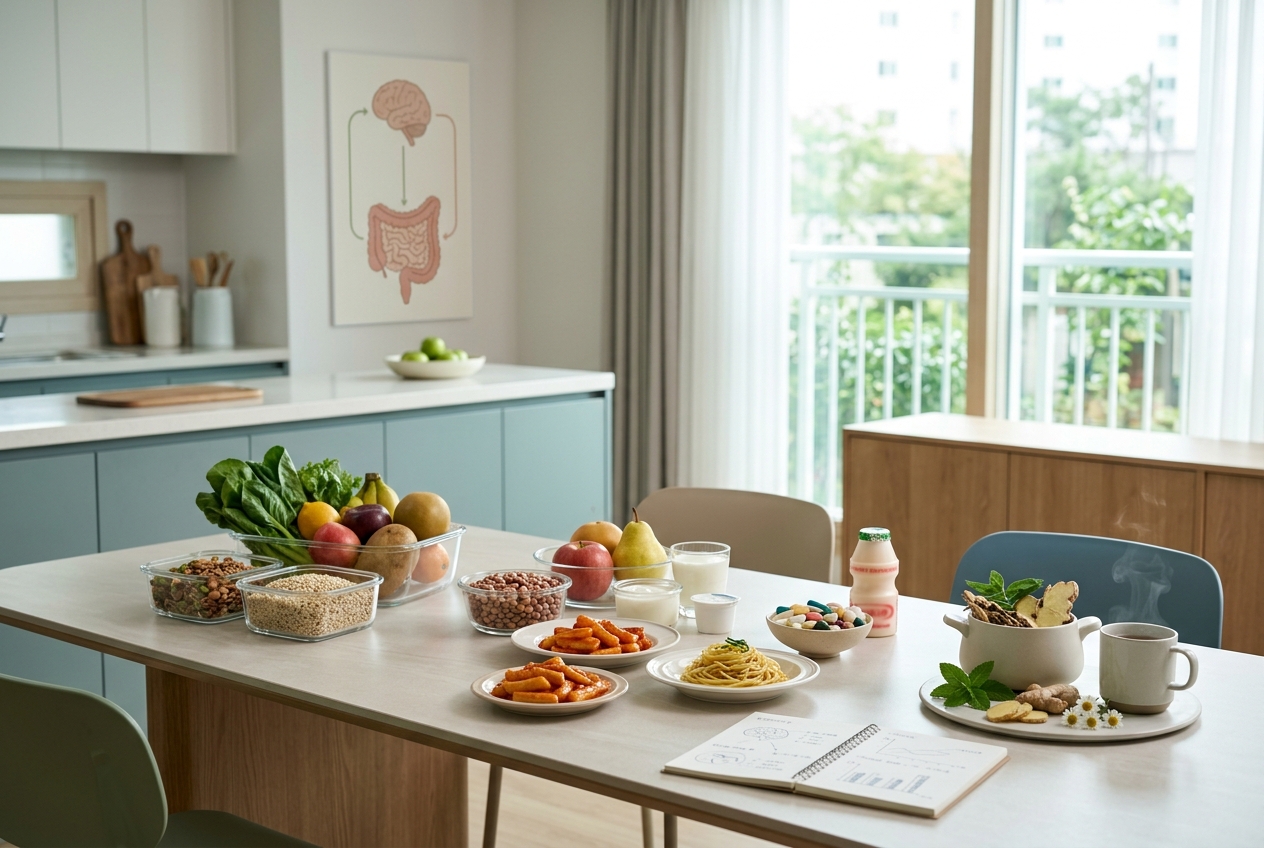
For IBS patients, diet accounts for half of the treatment. A 'low-FODMAP diet' is a method of reducing gas production in the gut by limiting sugars that are easily fermented. Foods to avoid include onions, garlic, legumes, wheat, apples, pears, and milk. On the other hand, rice, potatoes, bananas, cucumbers, and carrots are relatively safe.
However, unconditional restriction can lead to nutritional imbalance. It is recommended to strictly limit intake for 2-4 weeks when symptoms are severe, and then add foods one by one to keep a 'food diary' to see which foods your gut reacts to. In the food diary, it is good to record in detail the meal time, menu, intake amount, and the state of your gut 2-6 hours after the meal. Creating your own 'danger food list' through this is the key to long-term management.
Comparison Criteria: What to Eat and What to Avoid
The most important criterion when choosing food is 'fermentability.' High-FODMAP foods are rapidly fermented by gut bacteria, drawing in water and creating gas. Conversely, low-FODMAP foods produce less gas during the digestion process. For example, you need substitution strategies such as choosing lactose-free milk or almond milk instead of regular milk, and using rice flour or oat products instead of wheat bread. Eating speed is also important. Just by having the habit of chewing food slowly and thoroughly, you can reduce the digestive burden on the stomach and improve the state of food entering the gut.
Alleviating the Correlation Between Stress and the Gut

The gut is so sensitive to emotions that it is called the 'second brain.' If anxiety or tension persists, the gut's peristaltic movement becomes abnormally fast or slow. To control this, abdominal breathing and meditation are recommended. 10 minutes of deep breathing a day activates the parasympathetic nervous system and relieves gut tension. Also, light walking is the best exercise to help regular gut movement. Exercise contributes to maintaining regular bowel activity by helping to expel gut gas and promoting peristalsis.
Practical Method: Relaxation Therapy for the Gut
On days when stress is high, 'abdominal warm compresses' are recommended. Simply placing a warm heating pad on your stomach can help relieve tension in the gut muscles and be effective in pain relief. Also, during meditation, try 'abdominal breathing' for 5 minutes, focusing on your breath while feeling your belly expand and contract. This is an effective tool to stop the brain's warning signals. Besides this, yoga poses like the 'child's pose' or 'cat pose' are very effective in relieving abdominal tension.
Daily Practice Guide and Precautions
Regular bowel habits are a process of training the gut. Practice going to the restroom at the same time every day, but avoid sitting on the toilet for too long. Also, while water intake is important, caffeine-containing beverages stimulate the gut, so avoid them if possible. If symptoms suddenly worsen or are accompanied by bloody stools, weight loss, or anemia, this may be a sign of a disease other than IBS, so you must visit a hospital. In particular, changes in bowel habits that occur for the first time after the age of 50 require a thorough medical examination.
Selection Criteria: Medication and Supplements
If symptoms are too severe to carry out daily life, you can consider prescriptions for antispasmodics that control gut motility, constipation relievers, or probiotics that improve gut flora through a specialist. However, keep in mind that medication is only an auxiliary means, and the fundamental solution is ultimately the correction of lifestyle habits. When choosing probiotics, you should consider which strain suits you, the survival rate of the lactic acid bacteria, etc., and observe the progress while taking them for at least a month.
Conclusion: Checkpoints to Protect Gut Health
IBS is not a disease that is cured in a short period, but a disease to be managed. Look back at your lifestyle patterns and start writing a meal diary from today. Just by recording what you ate when your stomach felt comfortable and in what situations the pain was severe, you can find clues for treatment. Also, do not forget to check your gut condition through regular checkups. Your daily life is enjoyable only when your gut is comfortable. I hope you change one small habit starting today to regain peace in your gut.
This content is for general information purposes only and cannot replace medical diagnosis. If symptoms persist, please consult a gastroenterologist.
Frequently Asked Questions
Does IBS require medication?
If symptoms are severe enough to interfere with daily life, you can be prescribed medication to lower gut sensitivity or control constipation/diarrhea. Be sure to consult with your doctor.
Are probiotics helpful?
There are large individual differences. It is recommended to take them for 2-4 weeks to observe changes in symptoms to find the strain that suits you.
Will I be cured if I don't get stressed?
The goal is to minimize discomfort by managing symptoms rather than a complete cure. Lifestyle habits and diet control must be carried out in parallel.
What kind of exercise is good?
Rather than intense exercise, exercises that help blood circulation without straining the gut, such as walking, yoga, and light stretching, are effective.