A monthly rent contract is more than just moving into a new living space; it is the first step toward protecting your valuable deposit and starting a stable life. Before signing the contract, there are more factors for a tenant to carefully examine than you might think. Beyond just considering the monthly rent and deposit amount, you must comprehensively consider the legal status of the building, the landlord's reliability, and the potential for future disputes. Since housing stability is directly linked to quality of life, it is necessary to systematically prepare for every step of the contract process.
Checking the Real Estate Register: Understanding Ownership and Rights

The most basic first step is to obtain and check the real estate register (Deunggi-bu Deungbon). You should check it on the day of the contract and once more right before paying the balance. The real estate register is like a 'resume' for the property. It is divided into the Title Section, Section A (Gap-gu), and Section B (Eul-gu). In Section A, you must check who the owner is and whether there are any restrictions on ownership, such as provisional seizures or injunctions. In Section B, it is important to identify the mortgage rights, i.e., how much bank debt exists.
If a mortgage is set, it is safe to ensure that the total of the deposit and the mortgage does not exceed 70-80% of the housing value. If it exceeds this range, there is a high risk that you will not be able to recover your deposit in full if an auction occurs. Carefully compare Section A and Section B of the register and ensure that the person you are contracting with matches the owner listed. If an agent arrives, you must thoroughly verify their legal authority through a power of attorney and a certificate of seal impression. When contracting with an agent, you must use a method such as having a video call with the owner or transferring the contract deposit directly to the owner's account.
Checklist: Real Estate Register Analysis Points
- Are the owner and the contractor the same person?
- Are there any dangerous registrations in Section A, such as provisional seizures, injunctions, or auction commencement decisions?
- Does the sum of the maximum debt amount in Section B and the deposit fall within 70% of the housing market value?
- Is there a trust registration? (Trust registrations are very complex and require caution.)
Additionally, you must check whether the property is a 'multi-unit building' (Jip-hap geon-mul) according to the register. Multi-family houses (Da-ga-gu) are classified as single-family homes and do not have individual registrations for each unit, so it is essential to understand the rights regarding the entire building. On the other hand, multi-household houses (Da-se-dae) have individual ownership for each unit, so separate registers exist for each. You must clearly understand this difference to minimize risks that may arise when recovering your deposit.
Checking the Building Ledger and Illegal Construction Status

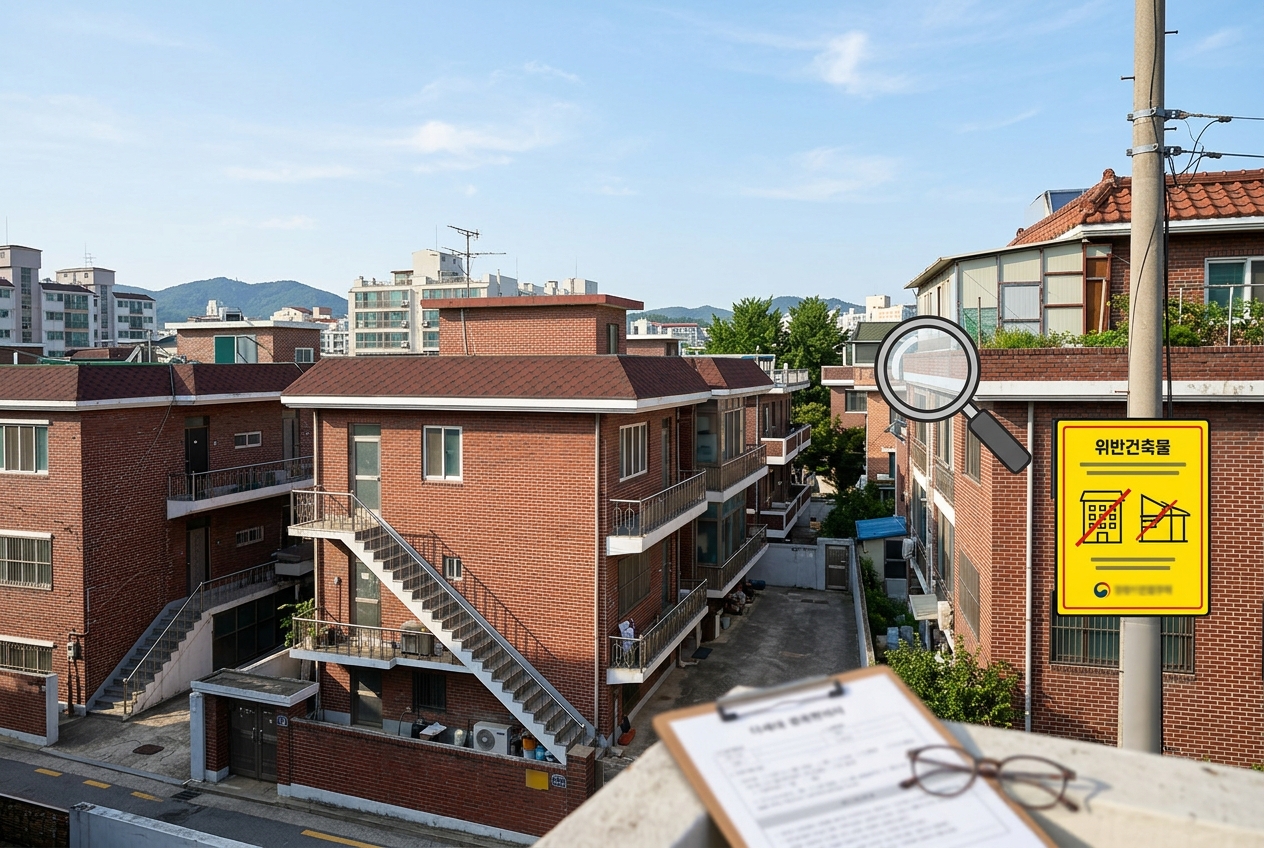
The real estate register alone is not enough. You must check the building ledger to see if the building was constructed legally and if it is an illegal structure. In the case of multi-family houses, there are often cases where temporary structures are installed on the roof or rooms in multi-room houses are illegally partitioned. Such illegal structures may prevent you from filing a move-in report (Jeon-ip sin-go) or make it difficult to secure the right of opposition (Dae-hang-ryeok) to protect your deposit.
Anyone can view this for free via the Government24 website or mobile app, so be sure to check it before signing. If there is a yellow mark labeled 'Illegal Building' on the building ledger, you should be cautious. This is evidence that the building does not meet legal standards, and future disadvantages such as the imposition of enforcement fines or loan restrictions could extend to the tenant. Also, check whether the building's usage is 'residential' or 'neighborhood living facility.' If you rent a place designated as a neighborhood living facility for residential purposes, you may be refused deposit insurance or be unable to obtain a jeonse loan when recovering your deposit later. In particular, illegally extended verandas or unauthorized changes in usage are strictly filtered out during insurance company reviews, so it is necessary to compare the drawings in the building ledger with the actual site before signing.
The Importance of Special Terms and How to Write Them Specifically
Special terms written in the contract serve as the strongest basis in the event of a dispute. The key is to supplement parts that are lacking in the standard contract. For example, the phrase 'The landlord shall not set up any security rights until the day after the balance payment' is very important. Since a tenant's right of opposition arises at 0:00 on the day after completing the move-in report and occupancy, this is to prevent the landlord from taking out a loan in the meantime.
Responsibility for repair costs of facilities should also be clarified. Take photos of any damage found before moving in, send them to the landlord, and specify the scope of repairs in the contract. Things that seem trivial, such as 'checking the condition of wallpaper and flooring upon move-in' and 'specifying the repair party for basic appliance malfunctions,' are keys to preventing deposit return disputes when moving out. It is better to clearly state 'who, when, and how' to repair rather than using ambiguous expressions. For example, defining specific scopes, such as 'the tenant bears the cost of consumable replacements, while the landlord bears the cost of structural defects,' is a way to reduce future conflict.
Examples of Essential Special Terms for Contract Writing
- The landlord shall maintain the current status of rights until the day after the balance payment.
- If an illegal structure is discovered, the landlord shall take full responsibility, and the contract may be terminated.
- Upon moving out, the obligation for restoration is waived except for intentional damage, excluding natural wear and tear.
- If it is impossible to sign up for jeonse deposit return insurance, the contract shall be voided and the deposit returned.
- In the event of a defect, the landlord shall repair it within 7 days of the tenant's notification.
When writing special terms, it is also important to keep the negotiation process with the landlord as evidence, such as in writing or via messages. Since verbal agreements are highly likely to be overturned later, even for detailed adjustments that are difficult to add to the special terms, you must leave them as text messages to confirm that both parties have agreed.
Post-Move-in Management and Deposit Protection Measures
Once the contract is finished, you must file a move-in report and obtain a fixed date (Hwak-jeong il-ja) immediately upon moving in. This is an essential procedure to secure the right of opposition and the right to priority repayment under the Housing Lease Protection Act. Nowadays, you can apply easily online. You can visit the local community center or use Government24 for the move-in report. The fixed date gives legal effect to the lease contract, granting the right to receive dividends ahead of junior creditors in the event of an auction.
Recently, signing up for jeonse deposit return guarantee insurance has become common. Even for monthly rent, if the deposit amount is large, you should consider signing up. Deposit protection cannot be emphasized enough. Checking whether the landlord has any tax arrears is also a good method. Since tenants have the right to request to view the landlord's unpaid national taxes, actively use this to prevent unexpected seizure situations. Also, immediately after moving in, you must go through an 'move-in inspection' process where you carefully check for defects in the house and leave them as photos or videos to avoid unnecessary restoration disputes when moving out.
On the day of moving, settle utility bills by checking the meters and ensure there are no unpaid charges from the previous tenant. This is a procedure to prevent unnecessary cost burdens that occur during the management fee settlement process. Also, notify the landlord immediately upon discovering condensation, mold, or leaks that occur after moving in and request repairs. If left unattended, the responsibility for restoration may be passed on to the tenant later, so keeping a record of the notification time and content is a very important habit.
Conclusion: Being Thorough is the Way to Protect Your Assets
A monthly rent contract is not just an act of renting a house, but a legal transaction that protects your living environment and assets. Every step, from checking the real estate register to reviewing the building ledger, specifying special terms, and filing the move-in report and fixed date, is organically connected. Neglecting even one of these can lead to high costs and mental stress later.
The most important thing is not to rush the contract. Even if the landlord urges you, you must check the documents yourself, ask questions clearly, and keep a record of the answers. Only a prepared tenant can enjoy a safe living life.
※ This information is a guide to items to check during a general lease contract. In the event of actual legal disputes or specific situations, it is recommended to check the relevant laws or seek help from a legal expert.
Frequently Asked Questions
When is the best time to check the real estate register?
It is safest to check it a total of three times: right before the contract, on the day of the contract, and right before paying the balance. This is because the status of rights can change at any time.
What problems can occur if it is an illegal building?
The move-in report may not be accepted, or it may be difficult to secure the right of opposition. Also, there is a high possibility that financial institutions will refuse to provide guarantee insurance, which carries risks for deposit recovery.
Must special terms be written in the contract?
Yes, it is difficult to prove the legal effect of verbal promises. Minor repair scopes or promises to maintain the status of rights must be specified in the special terms section of the contract to be protected.
When should I file the move-in report and get the fixed date?
It is best to do it on the day you move in. Since the right of opposition arises at 0:00 on the day after completing the move-in report and occupancy, you should process it as soon as possible.
How can I check if the landlord has tax arrears?
With the landlord's consent, you can apply for 'viewing unpaid national taxes' at the local tax office. Requesting this from the landlord before the contract to check for any arrears is a great help in protecting your deposit.