Overseas stock investment is more than just buying shares of companies across borders; it is a process of growing alongside innovative companies worldwide. The biggest appeal is the ability to diversify your portfolio by investing directly in global blue-chip stocks like Apple, Microsoft, and NVIDIA, or innovative startups, rather than being limited to the domestic market. However, for beginners, the entry barrier can feel high due to unfamiliar factors such as complex exchange rates, taxes, and time differences. In this article, we will examine the core concepts and preparation steps that those starting overseas stock investment must know.
What should I prepare first for overseas stock investment?

The first thing to do is to open a brokerage account that allows overseas stock trading. Recently, you can easily open an account non-face-to-face via smartphone apps. Since each brokerage firm offers different exchange rate preferential benefits and fee structures, it is important to choose one that fits your investment style. Once you have opened an account, the next thing to consider is 'currency exchange.' Since overseas stocks are traded in the currency of the respective country, the process of converting Korean Won to Dollars or other foreign currencies is essential. Recently, many brokerages offer a 'Won-based ordering service' where the brokerage automatically converts the currency when you place an order in Won, so it is a good idea for beginners to actively utilize these convenient features.
There are three main checkpoints when choosing a brokerage firm. First, the exchange fee discount rate. Since fees incurred during currency exchange directly affect your return on investment, reducing fees is important the more you trade. Second, whether real-time quotes are provided. Since overseas stock markets generally provide delayed quotes, you should choose an app that provides real-time quotes for free or has good accessibility. Third, the interface of the trading platform. Check if the ordering method is intuitive and if it is well-equipped with reports or analysis tools. Also, checking whether the MTS (Mobile Trading System) is stable and what the response system is in case of failure is a very important factor in actual investment.
Once you are prepared, it is time to think about which stocks to buy. Rather than blindly following stocks that others say are good, I recommend looking at companies that make services and products you are familiar with or use frequently in your daily life. While it is good to analyze a company's financial statements in depth, for beginners, simply checking what business model the company uses to make money and whether it belongs to an industry that can continue to grow steadily is enough study. Also, practice identifying the market share of the industry the company belongs to and what its competitive advantages (economic moats) are compared to competitors. If reading financial statements is difficult, it is good to develop a habit of consistently checking at least the growth trend of sales, the trend of operating profit margins, and the debt ratio.
Direct Investment vs. ETF Investment: Which method is right for me?
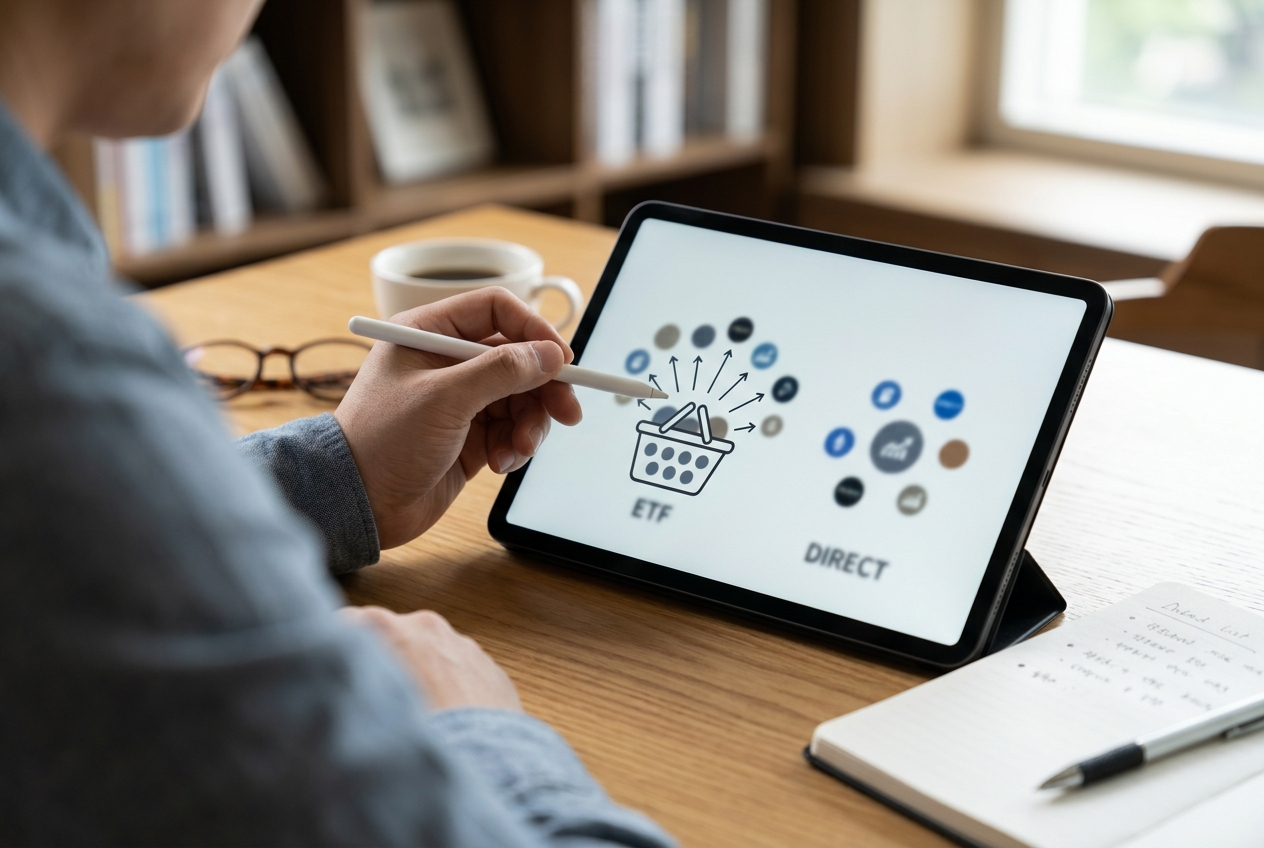
If choosing individual stocks directly is burdensome, using ETFs (Exchange Traded Funds) can be a reasonable alternative. ETFs are products that bundle multiple stocks and can be traded like stocks, making them convenient to manage. For example, if you want to invest in the entire US tech sector, you can buy an ETF that tracks the relevant index to diversify the risk of individual companies and follow the market's overall return.
The selection criteria for ETF investment are 'management fees' and 'trading volume.' Since management fees are deducted from your returns throughout the investment period, it is advantageous to choose products with the lowest possible fees. Also, if the trading volume is too low, it may be difficult to buy or sell at the price you want, so it is better to focus on large ETFs that are sufficiently traded in the market. While direct investment focuses on the growth of individual companies to seek excess returns higher than the market index, ETFs are specialized in managing risk while following the market's average performance. For beginner investors, rather than investing 100% in volatile individual stocks, it is psychologically much more stable to keep market-tracking ETFs as core assets and mix in individual stocks as a satellite strategy.
For beginners, I recommend a strategy of keeping index ETFs that track the entire market at the center of your portfolio rather than focusing on individual stocks from the start, and gradually increasing the proportion of sector ETFs or individual companies in industries you are interested in as your study deepens. This is the safest path to enjoy global market growth while reducing the volatility of your total assets. Another factor to consider when choosing an ETF is the 'reliability of the asset manager' and 'tracking error.' Checking how accurately it follows the index and how verified the asset manager is in the market is also an essential checklist for long-term investors.
Solving Time Differences, Exchange Rates, and Tax Issues

Unlike domestic stocks, overseas stocks have time differences. In the case of the US market, the market opens at night in Korea, so you must consider that real-time response is difficult. Therefore, a strategy of holding stocks while believing in the intrinsic value of the company from a long-term perspective is much more advantageous than short-term trading. Also, exchange rates directly affect returns. If you buy stocks when the dollar is weak and sell when it is strong, you can aim for exchange gains, but you should always keep in mind that in the opposite case, even if you make a profit on the stock price, the total return may be reduced due to exchange losses. To prevent this, you can consider split exchange strategies that take exchange rate volatility into account or use currency-hedged ETFs.
Taxes are also an indispensable part. A 22% capital gains tax is imposed on the amount exceeding 2.5 million KRW per year from profits generated through overseas stock trading. Since this is a different tax system from domestic stocks, you must be careful not to forget the capital gains tax reporting period, which takes place every May. There is a possibility of being subject to comprehensive financial income taxation, so if your investment scale grows, it is essential to consult with a tax accountant or carefully check relevant information. Since taxes are the final step in confirming investment profits, you need to develop a habit of calculating the profit and loss generated each year in advance. I recommend that beginners actively use the brokerage's agency service for capital gains tax reporting, as it can be done relatively conveniently.
Common Mistakes Beginners Make and Preventive Measures
One of the mistakes many beginner investors make is underestimating 'information asymmetry.' Compared to domestic companies, it is difficult to access news or reports on overseas companies in real-time. Therefore, to overcome language barriers, you should use translation tools and develop a habit of consistently reading reliable economic media and brokerage reports. Also, it is important to establish your own investment principles so that you do not make the mistake of selling at the bottom out of fear in volatile market situations.
A concrete preventive measure is 'split buying.' Rather than investing all your funds at once, investing a certain amount every month in a savings-like manner has the effect of lowering the average unit price. Also, when the stock price falls temporarily, instead of selling out of fear, ask yourself if the reason you first bought this company is still valid. If the business model has not been damaged, a temporary stock price drop can actually be a good buying opportunity. Conversely, chasing a rally when the stock price is soaring should be avoided as it maximizes volatility risk. Remember that while market volatility is an external factor that investors cannot control, your buying timing and asset allocation are areas you can control.
Final Checklist for Successful Overseas Stock Investment
The last point I want to emphasize is the 'power of recording.' Record why you bought this stock, what your thoughts were at the time of purchase, and what expectations you had. Records become a great asset when reviewing later. Successful investors go through the process of constantly looking back at their past decisions and improving them. Please remember that overseas stock investment is not a short-term gamble but a means for steady asset growth.
A point to be careful about during the investment process is to exclude emotional responses. Market noise occurs constantly, and if you react to each one, you will only increase the burden of fees and taxes due to frequent trading. Patience to watch the flow of the market calmly while investing in companies you understand with a long-term perspective is more important than anything else. If you start small based on what we learned today and build experience, you will be able to grow into a successful investor in the global market. Investing is like a marathon. Remember that finding your own pace to finish to the end is more important than the speed at the beginning.
Financial investment involves the risk of principal loss, and all investment decisions must be made under your own judgment and responsibility. Refer to expert advice, but final decisions should be based on your own analysis.
Frequently Asked Questions
Do I definitely need dollars to invest in overseas stocks?
You can exchange and hold dollars directly, but recently, you can easily buy overseas stocks with Korean Won by using the 'Won-based ordering service' provided by brokerage firms.
What are the taxes when investing in overseas stocks?
A 22% capital gains tax is imposed on the amount exceeding the basic deduction of 2.5 million KRW from the annual profit generated from overseas stock trading.
Do I have to trade US stocks only at night?
The regular market opens at night, but depending on the brokerage, pre-market or after-market trading is often supported, allowing you to use trading hours flexibly.
What is the most recommended overseas stock investment method for beginners?
If analyzing individual stocks is difficult, diversifying your investment through ETFs that track the entire market is a good way to manage risk and start stably.