As buildings become taller and more complex, the importance of fire safety is being emphasized more than ever. In this environment, the Fire Facility Manager has established itself as a key professional role responsible for the fire safety of buildings. Beyond simply fulfilling legal obligations, this certification is gaining high interest among many professionals as it involves acting as a technical guardian who protects the lives and property of citizens.
Key Roles and Responsibilities of a Fire Facility Manager

A Fire Facility Manager performs the inspection and maintenance of fire facilities in specific fire-target buildings in accordance with the Act on Installation and Management of Firefighting Systems. Specifically, they lead operational function inspections and comprehensive precision inspections, determine whether inspection results are appropriate, and establish repair measures. Their most important mission is to verify compliance with regulations and ensure that fire equipment can function properly in actual fire situations. Furthermore, their scope is expanding to include providing technical advice at design or construction sites and consulting for fire prevention.
The authority and responsibility held by a manager in the field are significant. As the person responsible for preparing and submitting inspection reports to the competent fire station, they can face legal punishment if they report falsely or neglect inspections. Therefore, high ethical standards and accurate technical judgment are required. A manager does not just check mechanical figures; they must evaluate the completeness of the fire safety system by comprehensively considering the building's structural characteristics and smoke movement paths during a fire. As a safety manager on-site, they are the last line of defense, determining how effective the building's fire facilities will be for initial response before firefighters arrive.
At the start of their work, they review the building's fire safety plan and compare it with records written by the fire safety manager to prioritize on-site inspections. During inspections, they conduct performance tests for each type of fire facility; this requires patience to verify everything from sprinkler discharge pressure and indoor hydrant flow rates to the interlocking circuits of fire receiver panels. Defects discovered during this process should not just result in repair recommendations; to be recognized as a true expert, one must analyze the root cause of the defect and suggest measures to prevent recurrence.
Examination System and Qualification Process

The Fire Facility Manager exam is divided into a first-round written exam and a second-round practical exam. The first round is a multiple-choice test covering fire safety standards, the structure and principles of fire facilities, and fire-related laws. The second round consists of essay-type and practical calculation-type questions, requiring a deep practical understanding. Many candidates struggle with the second round because it requires more than just memorizing theory; it demands the ability to interpret actual blueprints and derive the capacity of fire equipment through calculations.
Eligibility is also strictly limited. Only those with a certain level of expertise, such as those with practical experience after obtaining a Fire Equipment Engineer certification or those who have graduated from a fire-related department and accumulated experience, can challenge the exam. This is a mechanism to maintain the authority of the certification and ensure professionalism in the field. The most important part of the study process is grasping the trend of legal amendments. Familiarizing oneself with the latest revisions of fire-related laws and the National Fire Safety Code (NFSC) is not an option, but a necessity. For the second round, candidates must practice not only the derivation of calculation formulas but also constructing fire scenarios and logically describing the sequence of equipment operation.
A key checkpoint when preparing for the exam is 'connectivity with practice.' The first round is a stage to build fundamentals; one should not just memorize legal clauses but understand the intent behind their enactment. Since the second round is an essay-type exam, practice in structuring answers logically is necessary. For example, instead of just writing the calculation value requested, one should include the technical basis, such as which formula was used, why it is valid, and how the final result affects on-site equipment, to achieve a high score. For candidates with short practical experience, it is recommended to consistently supplement blueprint interpretation skills through fire-related practical communities or technical materials.
Checkpoints in the Field
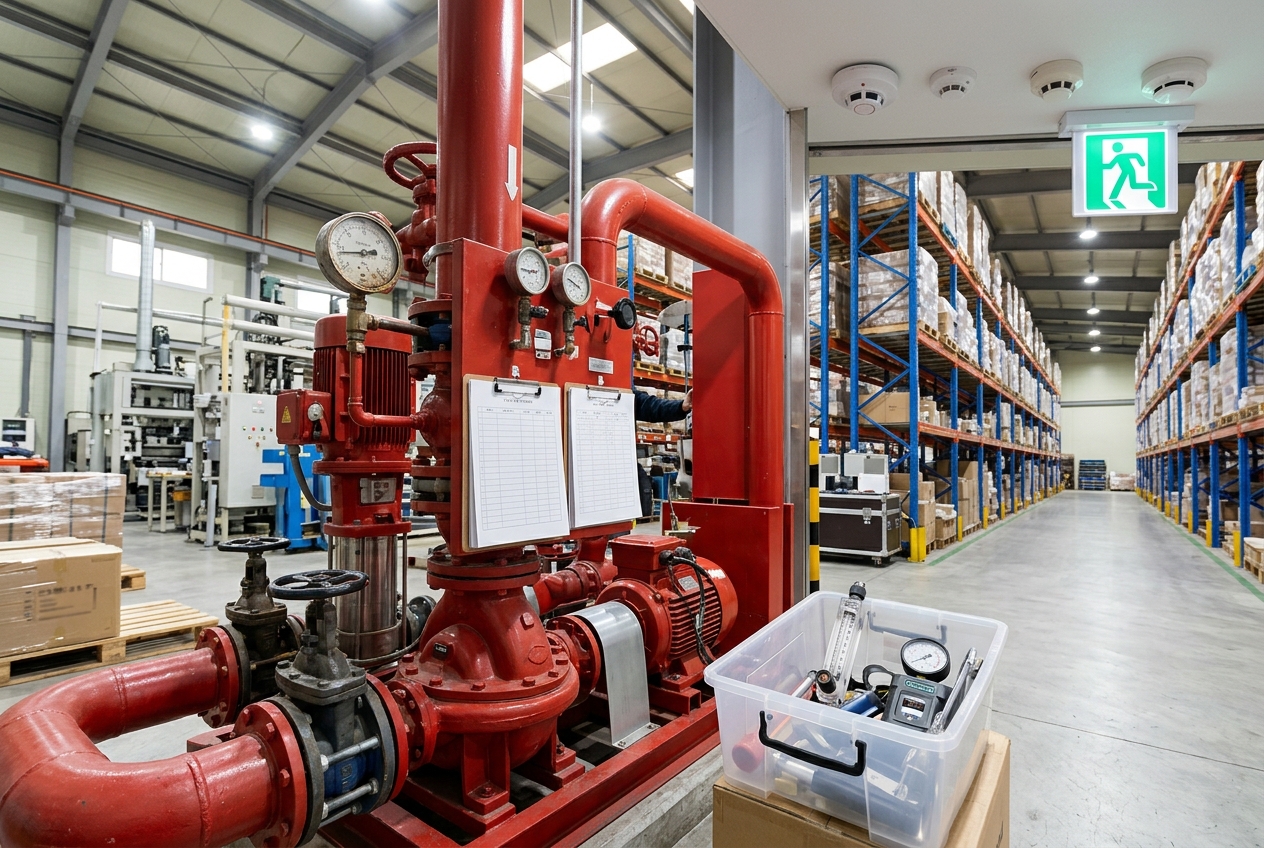
When entering the field, the first thing one encounters is the variety of building types. Because the types of fire facilities installed differ depending on the building's purpose—such as apartments, office buildings, factories, or hospitals—a manager must have well-rounded knowledge of a wide range of equipment, including water-based extinguishing systems, gas-based extinguishing systems, and alarm systems.
Checkpoints that must be verified during on-site inspections are as follows: First, check if the fire pump performance test results match the design documents. Specifically, one must precisely measure whether the head and flow rate meet the specified values. Second, check for malfunctions in fire detectors and their interlocking status with the receiver panel. Verify if the installation location of the detectors can properly sense heat currents and if the receiver panel circuits are operating normally. Third, evaluate whether evacuation equipment and exit lights are clearly identifiable in emergency situations. The illuminance of exit lights and the operation of emergency power supply devices are directly linked to human evacuation. These processes must be meticulously recorded in the management ledger, and if inspection results are found to be inadequate, they must be immediately reported to the management entity to establish a correction plan.
Additionally, a point easily overlooked in the field is 'collaboration with the management entity.' While the manager is an external inspector, daily building management is handled by the facility management team. Therefore, when delivering reports on problems found during inspections, it is helpful for smooth operations to explain them in language that on-site managers can understand rather than just listing technical jargon, and to suggest maintenance priorities. Also, conducting virtual training based on fire scenarios with the management entity is a good way to demonstrate one's competence as an expert.
Career Paths and Prospects for Fire Facility Managers
After obtaining the certification, one typically enters fire facility inspection companies, fire safety management agencies, or the management departments of large buildings. Recently, as social awareness of fire safety has increased, related laws have been strengthened, and the scope and frequency of inspection targets are increasing. This is leading to an increase in demand for Fire Facility Managers.
Many also use this as a stepping stone to obtain a Professional Engineer (Technician) certification or become independent as a consultant in related fields. However, as technology advances, fire systems are becoming digitized, making continuous self-development essential. Not remaining stuck in past knowledge but learning IoT-based fire systems or smart building management technology is key to future competitiveness. In particular, as large logistics warehouses and skyscrapers increase, the understanding of advanced fire detection systems and interlocking control technology will be an important factor in determining a manager's value.
In terms of prospects, the Fire Facility Manager is classified as a stable profession relatively unaffected by economic fluctuations. This is because the legal requirement for periodic inspections ensures continuity of work. However, it is necessary to expand one's work beyond simple inspections into areas that create added value, such as predicting fire risks through data analysis or proposing optimized designs for fire systems. As fire-related laws are expected to become more detailed and stricter in the future, consulting ability based on professional knowledge will be a key competency to elevate one's career as a manager.
Study Strategies and Efficient Preparation Methods
The Fire Facility Manager exam is difficult to complete in a short period. Because the second-round practical exam is highly difficult, studying with the second round in mind is necessary from the first-round preparation stage. A method recommended by many successful candidates is to perfectly master the National Fire Safety Code (NFPC). This code is the foundation for all practical work and exam questions.
Utilizing online lectures for time management is also a good method. One must check if the latest amended laws are reflected in real-time and identify recurring types through the analysis of past exam questions. Also, sharing blueprints or calculation processes with a study group is a great help in supplementing parts that are easy to miss when studying alone. When studying, understanding the structure and principles of each facility is the priority, and building background knowledge on why such standards were created is better than simple memorization to increase application ability in the field. It is important to maintain a routine of studying a set amount each week and taking mock exams in an environment similar to the actual test.
For efficient learning, creating your own 'error note' is recommended. In particular, mistakes in calculation problems are common in the second-round practical exam. To avoid losing points on trivial parts like unit conversion or decimal point processing, organize the types you frequently get wrong whenever you solve past questions and repeat them until just before the exam. Also, make it a habit to create a separate summary book for legal amendments to keep them up to date. Since laws are the core basis for exam questions, knowing the revised parts accurately is a stepping stone to a high score.
Precautions from Current Professionals
The most important thing to be careful about when working in the field is that it is directly linked to human life. There are many cases where figures on paper differ from the actual state of the site. When you discover facility aging or unauthorized modifications on-site, you need the fortitude to demand correct corrective measures without compromising. Also, conflicts may arise during communication with building owners or management entities; in this case, communication skills to explain logically based on legal grounds are one of the important competencies of a manager.
Finally, laws change frequently. You should periodically check announcements from the National Fire Agency and always keep a close eye on how revised standards are applied in the field. Please remember that a professional certification is not the end, but a process of increasing your value through continuous learning. It is good to make it a habit to read related academic materials and grasp technical trends to prepare for various unexpected situations that occur during work. I hope you will become a reliable partner who protects the safety of citizens with pride as a manager.
The profession of Fire Facility Manager has very high social value and is a field where professionalism can be recognized. I hope you achieve your dreams through systematic preparation. In the field, you must act with the mindset that every moment is a real-life situation. Do not forget the vigilance that neglecting even a minor defect can lead to a large fire later. Professionalism is completed not only by technical skills but also by the right attitude toward the field.
Frequently Asked Questions
What are the eligibility requirements for the Fire Facility Manager exam?
You need practical experience after obtaining an Engineer certification in a related field, or a certain period of practical experience after graduating from a fire-related department. Detailed qualification requirements can be found on the Q-Net website of the Human Resources Development Service of Korea.
What is the difference between the first and second round exams?
The first round is a multiple-choice written exam evaluating theoretical knowledge, while the second round is an essay-type and practical calculation-type exam evaluating design interpretation and problem-solving skills in the actual field.
Is the pass rate low?
The difficulty of the second-round practical exam is quite high, so the pass rate is on the low side. Sufficient practical understanding and a systematic study plan are essential.
What are the prospects after obtaining the certification?
Demand is steadily increasing due to the strengthening of regulations related to fire safety. You can enter various fields such as large facility management and consulting, in addition to inspection companies.