When an interview date is set, the first emotion you feel is often anxiety rather than excitement. Worries like 'What and how should I prepare?' or 'What if an unexpected question comes up?' are a natural process that everyone goes through. However, effective interview preparation is not just about memorizing answers, but a process of translating yourself into the company's language. Here is a step-by-step guide to the checklist and core strategies you need to start right now for a successful interview.
Step 1: Connecting Job Post Analysis with Corporate Understanding

Many applicants are in a hurry to list their experiences. However, interviewers are more curious about 'how your experience can be used to solve our company's problems' than 'what you have done.' The first checklist is corporate analysis.
First, print out the job posting again and highlight the core competencies with a highlighter. If the posting contains keywords like 'collaboration,' 'data analysis,' or 'quick execution,' you should prepare at least three episodes from your experience that can connect to these words. The key is not just to list past events, but to logically connect how that experience can produce results in the relevant job. To do this, you must go through the requirements of the Job Description (JD) one by one and match the evidence that your competencies meet those requirements with concrete examples.
Understanding the company's recent news, business direction, and differences from competitors is the absolute basic. However, don't just stop at collecting information; ask yourself, 'If I were a member of this company, what would I be worried about?' This thought process itself determines the depth of your answers in the interview. In particular, identifying the new business areas the company is focusing on or the latest industry trends and organizing your thoughts is enough to leave an impression on the interviewer as a 'prepared applicant.' It is important to go beyond memorizing the company's history and adopt an attitude of objectively analyzing the market situation the company is facing and proposing ways you can contribute.
Also, you need to practice identifying the company's talent model and core values and incorporating them into your answers. For example, if it is a company that emphasizes 'challenge,' you should take a strategy of prioritizing experiences where you achieved results without fearing failure; if it is a company that emphasizes 'trust,' you should prioritize cases where you solved problems honestly. This is not just about fitting into the company, but the most powerful means of persuasion to show that your values align with the company's direction.
Step 2: 1-Minute Self-Introduction and Structuring Answers

The beginning and end of an interview is the first impression. A 1-minute self-introduction is not just a time to recite your resume. You need a 'hook' that presents your most powerful weapon and delivers, in a short and bold way, why it is suitable for this job. Since the self-introduction is the first gateway to attracting the interviewer's attention, it is recommended to compose it concisely within 45-50 seconds by connecting core competencies and personality to the job.
When structuring your answers, it is good to use the 'STAR technique.' If you answer in the order of Situation, Task, Action, and Result, the content becomes clear without any fluff. Especially in the 'Action' part, describe in detail what you specifically worried about and through what process you solved the problem. Rather than just listing results, the 'details of the process' regarding what difficulties you faced and how you overcame them move the interviewer's heart. It is best if results can be presented in numbers, but if there are no numbers, it is also a good strategy to honestly mention the changed process, what you learned, or feedback obtained from colleagues. Structured answers are a major yardstick by which interviewers judge an applicant's logical thinking skills.
A point to note when structuring your answers is to maintain a 'top-down' approach. Interviewers prefer applicants who speak from the conclusion because they are managing a busy schedule. You should make it a habit to define your core competency in one sentence at the beginning of your answer, provide evidence to support it, and finish with a contribution plan after joining the company. Also, practicing controlling the length of your answers is necessary. If it's too short, it may seem insincere, and if it's too long, it may become boring. A 1-minute self-introduction is appropriate at around 300-400 characters, and you need to practice speaking a little slower than usual, considering that you may speak faster due to nervousness in a real situation.
Step 3: Listing Expected Questions and the Importance of Mock Interviews
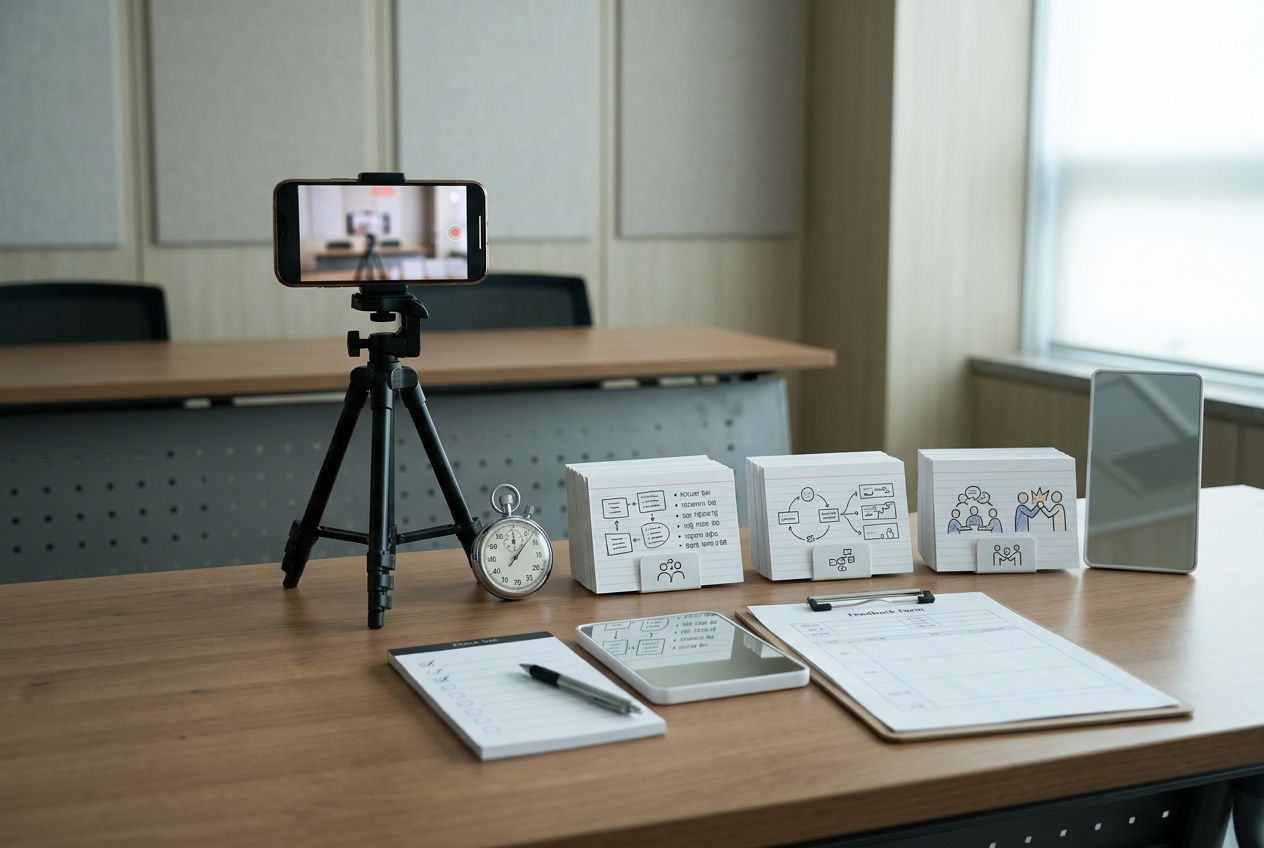
Expected questions are broadly divided into three categories. First, questions based on the self-introduction letter. Read what you wrote again and ask 'Why?' at least three times. Second, job competency questions. You should assume problem situations that frequently occur in the job and prepare your solutions. Third, personality and values questions. These are questions that ask about how you handle conflict situations, your fit with organizational culture, etc.
A mock interview is different from just talking in front of a mirror. If possible, try recording yourself answering. You can objectively identify unnecessary filler words, eye contact, or anxious hand gestures that you use more often than you think. It will be awkward and embarrassing at first, but the difference in confidence between someone who has gone through this process and someone who hasn't will be clearly revealed in the interview room. Watch the recorded video and repeat the process of checking and improving the speed of your answers, the tone of your voice, and changes in your facial expressions. Asking an acquaintance for feedback or listening to your answers from another person's perspective through a study group is also very effective.
During a mock interview, it is good to assume a real interview situation and use a timer to check your answer time. If your answer becomes too long, the core can become blurred, so practice the 'top-down' speaking method of stating the core conclusion first and then adding supplementary explanations. Also, you can minimize embarrassment in a real situation by practicing answering calmly even in stressful situations.
When conducting a mock interview, it is essential to prepare for 'follow-up questions.' Interviewers want to check the sincerity and logic hidden within the applicant's answers while listening to them. Questions like 'What was the most difficult part of that experience?' or 'If you went back to that situation, would you choose a different alternative?' are to see the applicant's response ability. To prepare for these follow-up questions, please consistently perform 'self-interviews' where you ask yourself questions from the opposite perspective every time you write an answer.
Step 4: On-site Precautions and Mind Control
The day of the interview is the day to show your skills, not the day to learn something new. For attire, neatness is the top priority. Rather than expensive clothes, clothes that fit your body well and are neatly laundered are better. Arrive 20 minutes before the interview time to adapt to the atmosphere of the waiting area and lightly organize your breathing. Always keep in mind that your attitude in the waiting room can also be an extension of the evaluation.
When listening to the interviewer's questions, an attitude of listening until the end is important. If you didn't understand the question, don't panic and it's okay to politely ask for the question again. Asking 'I'm sorry, but could you tell me the intent of the question once more?' is not a mistake, but is seen as a will to give an accurate answer. Rather than making up a lie when you receive a question you don't know, it is much better evaluated to answer honestly within the scope of what you know and show an attitude of wanting to learn. In moments of tension, it is good to take one deep breath and have the leeway to pause for a moment before starting your answer.
Eye contact with the interviewer is an expression of confidence. It is good to look at all interviewers evenly while answering and not lose your smile. Also, don't forget that the entire process from entering to leaving the interview room is subject to evaluation. A bright greeting and a polite attitude are excellent specs in themselves. Tension is a natural emotion, but an effort to control it and convert it into positive energy is necessary.
On-site, non-verbal elements are also very important. The volume of your voice when answering, stable eye contact, and neat posture are factors that determine the applicant's credibility. There is a tendency for your voice to tremble or become small when you are nervous, but practicing speaking with a half-tone lower and clearer pronunciation than usual can give a more professional impression. Also, just reducing unnecessary filler words (um, ah, like) in the middle of your answers can make you look like a much more logical and confident applicant.
Step 5: Final Checklist for Selection and Concentration
If you are feeling overwhelmed with interview preparation, try checking the following items one by one. If even one is missing, you should supplement it right now.
- Connecting 3 core job keywords with my experience
- Preparation for 3 versions of 1-minute self-introduction (job-centered, personality-centered, experience-centered) complete
- Preparation for follow-up questions asking 'Why?' for every sentence in the self-introduction letter
- Summary of company website and major news within the last 3 months complete
- Neat attire and checking the route to the interview location in advance
- Practicing listening attitude to grasp the intent of questions and smiling
- Securing my own 'killer' episode to respond to unexpected questions
- Basic understanding of the industry the company belongs to and grasping market share
- Calculating concrete performance indicators that can reveal my strengths
- Preparing questions to ask the interviewer last (reverse questioning)
An interview is not a place where I am evaluated, but a process where the company is looking for a colleague to work with. There is no need to act overly submissive or, conversely, to excessively package yourself. If you prepare with the mindset of delivering your value plainly, you can lead any interview proactively enough. Remember that the interviewer is not looking for a perfect person, but someone who can blend well with our organization and grow together.
Finally, after the interview is over, be sure to take time to review. If you record what you did well and what you lacked, you can show a much more developed appearance in the next interview. An interview is not something that ends at once, but the sum of experiences that you continue to accumulate. I sincerely cheer for your preparation process to lead to good results. If consistent practice and sophisticated strategies are added, you can definitely become the protagonist of the position you want.
Frequently Asked Questions
How should I structure my 1-minute self-introduction?
It is recommended to structure it in the order of clearly presenting your strengths most relevant to the job you are applying for, mentioning a short experience case that supports it, and then revealing your aspirations for how you will contribute after joining the company.
How should I deal with unexpected questions?
Rather than panicking and saying anything, it is better to ask for time to think for a moment. After politely asking, 'Could you give me a moment to think?', answer as logically as possible within the scope of what you know. It is better to honestly acknowledge the parts you don't know and add how you will learn in the future.
Is a mock interview absolutely necessary?
It is not mandatory, but highly recommended. This is because just objectively checking your answer speed, tone, facial expressions, and eye contact can greatly reduce tension in a real situation.
What level should my interview attire be?
Matching the atmosphere of the company you are applying to is the basic. If it is a conservative company, a suit is safe, and if it is an IT company with a strong autonomous dress culture, neat and clean business casual is appropriate. Most of all, it is important that it is clean and comfortable for you.