Health insurance premiums are one of the fixed expenses determined by your income and assets. While many people only check the amount after receiving the monthly bill, checking in advance and understanding the basis for the calculation is the first step in asset management. Checking your health insurance premiums is more than just verifying a number; it is a process of understanding how your economic activities are reflected in the premium calculation. We will look at when inquiries are useful and what points you should be aware of, step by step.
Reasons for Checking Health Insurance Premiums and Basic Concepts

The calculation method for health insurance premiums differs completely between workplace subscribers and regional subscribers. For workplace subscribers, premiums are based on monthly salary and are split equally between the employer and the employee. However, for regional subscribers, premiums are calculated by scoring not only income but also assets such as vehicles and real estate. Therefore, it is important to first verify which category you fall into. Through an inquiry, you can determine if your premium has been calculated correctly or if adjustments are needed due to changes in income. In particular, if you do not apply for a premium adjustment when transitioning to a regional subscriber after leaving a job or when your income decreases, you may incur unnecessary expenses. Going beyond simply looking at the amount, the habit of carefully checking the calculation items increases economic efficiency.
Health insurance is the core of the social security system and follows the principle of ability-to-pay, where premiums are imposed in proportion to the subscriber's economic capacity. For workplace subscribers, it may be difficult to feel the impact as it is deducted from the monthly salary, but it is necessary to check the premiums and long-term care insurance premiums deducted each month through your pay stub. On the other hand, regional subscribers receive the bill directly, and by carefully examining the calculation details listed, you can objectively grasp your economic standing and asset status. Checking your health insurance premiums is like a regular health check-up for your financial situation, rather than just a means to verify the amount to be paid.
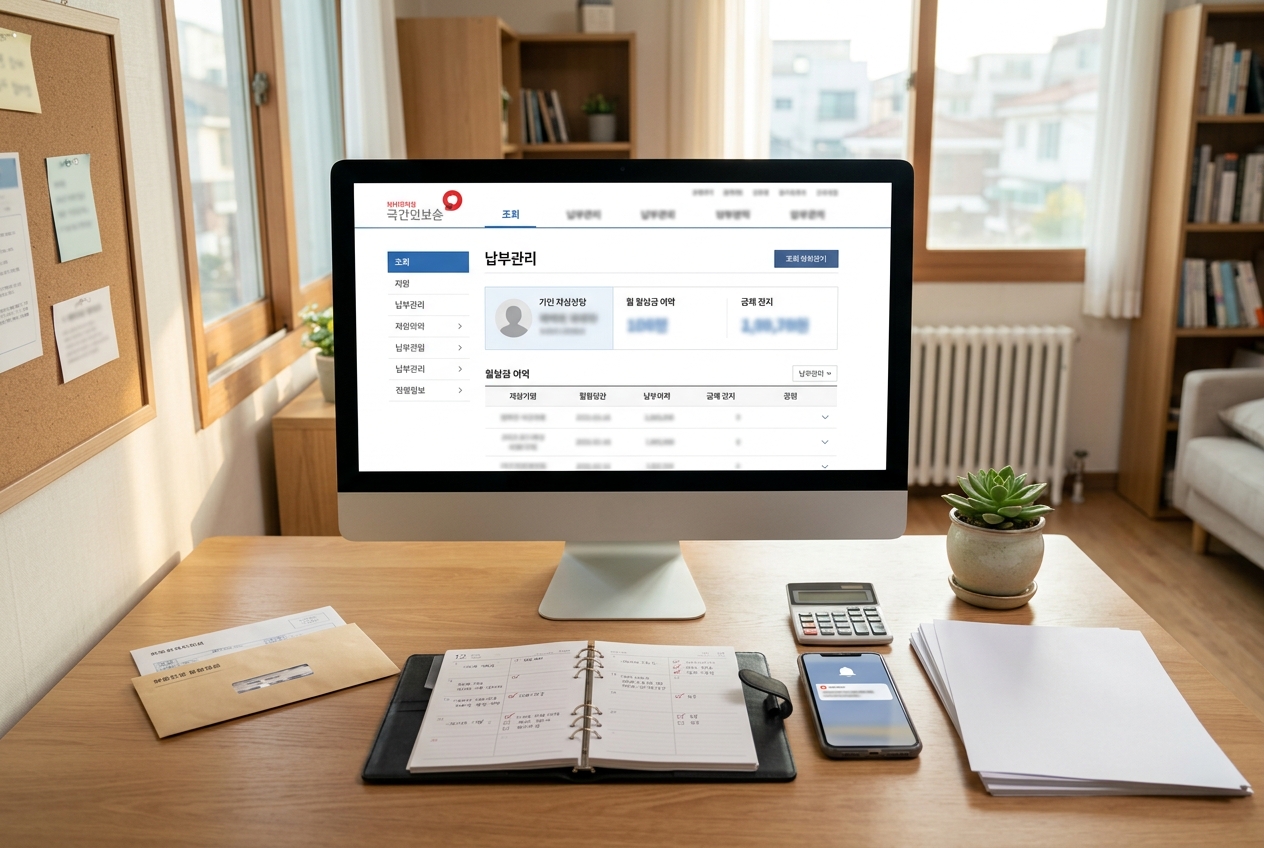
You can easily check your health insurance premiums through the National Health Insurance Service (NHIS) website or the mobile app, 'The Health Insurance (The건강보험)'. Using a joint certificate or simple authentication allows for real-time verification while maintaining personal information security. The biggest advantage is that you can see your qualification status, recent payment history, and any unpaid amounts at a glance. In particular, checking the settlement details after the annual report of total remuneration for workplace subscribers in April is a very important indicator for setting your annual household budget. Making it a habit to check can prevent sudden premium increases or late fees due to non-payment in advance.
Comparison of Inquiry Points for Workplace and Regional Subscribers

If you are a workplace subscriber, your premiums are settled through the report of total remuneration conducted every April. At this time, you may pay additional premiums or receive a refund based on the previous year's income compared to the premiums paid; checking in advance can prevent panic during the settlement period. On the other hand, since regional subscribers have their income and asset scores combined, you should be aware that premiums can change whenever there is a change in assets. Items such as 'asset deductions' or 'vehicle scores' act sensitively for regional subscribers. If your residence has changed or you have sold a vehicle, you should check through an inquiry whether the factors for premium changes have been reflected. If not, you must immediately submit relevant documents to the NHIS to request a correction. This is a legally guaranteed right, so you should not neglect checking.
The inquiry point for workplace subscribers is the accuracy of the 'monthly salary'. Sometimes, if the monthly salary reported by the company differs from the actual salary, the premium may be calculated incorrectly. It is recommended to develop the habit of comparing your income with the reported amount at the time of the annual settlement in April. For regional subscribers, you should check the sum of the 'unit price per point' and 'asset score'. In particular, recent increases in real estate official prices or changes in vehicle ownership value can have a significant impact on premiums. If you are a regional subscriber, you should print the calculation statement provided by the NHIS and carefully compare each item with your current situation. For example, in the event of business closure or unemployment, you should immediately apply for a regional subscriber premium adjustment; if left unattended, excessive premiums based on the previous year's income may continue to be charged.
A point to note when checking is the speed of real-time data reflection. Since premiums may be applied retroactively depending on when income data from the National Tax Service is transferred to the NHIS, if your premium has suddenly increased, it is best to first look at your recent income report details. If there are items that are difficult to understand, it is most accurate to inquire about the details through the NHIS customer center. In particular, for regional subscribers, the income and assets of all household members are combined and billed, so if there is a change in the economically active population within the household, you should immediately check this and take appropriate measures such as splitting the premium or separating the household. Considering the time lag in data synchronization, the key to management is to access the NHIS system before and after the premium bill is issued to check for any changes.
Strategies for Premium Reduction and Efficient Management
The most certain way to reduce premiums is to accurately report changes in income and assets. Especially for regional subscribers, there are many cases where they continue to pay high premiums because they did not report a decrease in income. You can receive an immediate premium adjustment by proving the income decrease using a 'Certificate of Resignation (Hae-chok)' or a 'Certificate of Income Amount'. Also, periodically check if you meet the requirements for dependent status. If a family member's income or assets exceed the criteria, their dependent status may be revoked. In this case, you will be converted to a regional subscriber and unexpected premiums will occur, so it is important to check in advance whether your family's eligibility is maintained.
The first thing to practice for efficient management is the 'habit of regular inquiry'. Immediately after the monthly bill is sent, or once every quarter, access the NHIS website to check your qualifications and billing details. This is a process of understanding how your current economic situation and social qualifications are connected, beyond just checking the amount. Also, increase payment convenience by applying for automatic transfers and prevent late fees due to non-payment in advance. Non-payment of health insurance premiums does not stop at the issue of late fees but can lead to disadvantages such as future restrictions on health insurance benefits, so special attention is required.
The checklist for premium management is as follows: First, check if the amount on the monthly bill matches the amount in the NHIS system. Second, report immediately when there is a change in income or disposal of assets. Third, set up automatic transfers and payment notifications to ensure no unpaid amounts occur. Fourth, review whether you can use the installment payment system when a settlement amount occurs. These management habits are of great help in preventing unexpected expenses and maintaining stable household cash flow. Additionally, since health insurance premiums are an item eligible for tax deductions during the year-end tax settlement, carefully keeping track of payment history is the way to maximize year-end tax benefits. Payment statements can be issued at any time on the website, which saves time when preparing documents for the year-end tax settlement.
Frequently Asked Situations and Responses Regarding Health Insurance Premiums
Sometimes you may feel that your health insurance premium has been set too high. In this case, do not panic and read the calculation statement in detail. If it is set higher than your actual income, you can correct it through an objection. The National Health Insurance Service discloses detailed calculation statements to guarantee the public's right to know, so it is recommended to actively utilize them. Also, if it is difficult to pay premiums due to financial difficulties, please check the 'Premium Reduction System'. If you meet certain requirements, you can receive a partial reduction in premiums. Since this is a system operated as part of welfare, it is necessary to carefully read the guidance on the website to see if your situation applies.
Applications for premium adjustments can be made via visits, mail, fax, or through the NHIS website or app. It is important to prepare objective data that can prove that your income has decreased or assets have been sold in advance. If you have difficulty in the application process, visiting an NHIS branch for consultation is also a good method. During the consultation, you should be prepared to explain the reason and period of your current income decrease and relevant documents in detail to lead to the most favorable adjustment. Remember that while the health insurance system is a pillar supporting the healthy lives of the people, its operation ultimately depends on the accurate information provision and management of each individual subscriber.
Ultimately, checking your health insurance premiums is not a passive verification but the beginning of active management. The key is to objectively grasp your income and asset status and utilize the system well to prevent unnecessary expenses. Since system changes are updated frequently, it is good to develop a habit of visiting the NHIS website regularly to check for the latest information. This information is a general guideline, and for individual detailed inquiries, we always recommend seeking expert help through the National Health Insurance Service customer center or the competent branch. Remember that as health insurance is the nation's safety net, understanding and managing it properly is the path to protecting your financial stability.
Frequently Asked Questions
Where can I check my health insurance premiums?
You can easily check them after logging in to the National Health Insurance Service website (nhis.or.kr) or the mobile app 'The Health Insurance'.
Why did my regional subscriber premium suddenly increase?
Premiums may increase when there are changes in income or assets (real estate, vehicles). Please check if recent income data has been reflected in the NHIS.
Can I adjust my premium if my income has decreased?
Yes, you can lower your premium by preparing documents that can prove the income decrease (Certificate of Resignation, Certificate of Income Amount, etc.) and applying for an adjustment to the NHIS.
How do I check my dependent status?
You can check whether you are currently registered as a dependent or if you are maintaining the eligibility requirements through the 'Qualification Inquiry' menu on the NHIS website.