After finishing your hospital visit, the concern that follows your medical bills is filing a medical expense insurance claim. Many people feel overwhelmed when they open an app or website to receive their insurance money, only to realize they don't know which documents are required. You might think, 'Isn't the medical bill receipt enough?' only to find that the insurance company requires more complex documentation, leading to the hassle of visiting the hospital again. To put it simply, the documents required for medical expense insurance claims vary depending on the size of the hospital, the details of the treatment, and the claim amount.
A point many people miss is the 'difference in documents based on hospital size.' The documents you need to obtain differ depending on whether it is a clinic or a general hospital, and specific diseases or detailed terms of the insurance policy may require additional paperwork. Today, we will walk through everything you need to know about preparing documents for a smooth insurance claim, step-by-step, and share some tips you shouldn't miss.
The first thing to remember is that the documents required for small claims of 100,000 KRW or less differ from those for larger claims. While many insurance companies now support simple claims via mobile apps, they still require detailed medical records for amounts exceeding a certain threshold. The most common mistake when filing a claim is omitting documents; specifically, if the 'detailed statement of medical expenses' is missing, the insurance company's review team cannot judge the appropriateness of non-covered items, leading to a request for supplementary documents.
Step 1: Understanding Basic Documents by Hospital Size

The foundation of a medical expense insurance claim is confirming 'where you received treatment.' Local clinics and large hospitals may have different document issuance systems and terminology. Generally, a 'medical bill receipt' is required in common. However, in most cases, this is not enough.
Clinics and General Hospitals
At local clinics or small hospitals, you must obtain a 'detailed statement of medical expenses.' Since the receipt only shows the total amount, the insurance review team needs to check the details to determine if non-covered items were appropriate. Additionally, documents containing the disease code are required; in some clinics, the disease classification code is included on the medical bill receipt. If it is not, you must request a 'medical certificate' or 'outpatient confirmation.' A checkpoint here is to confirm whether the hospital has an electronic chart system. Facilities with the latest systems can sometimes transmit documents directly via an app, so it is worth asking the administration office.
General Hospitals and Tertiary Hospitals
At large hospitals like university hospitals, the document issuance process is slightly more rigorous. Since there is a wide variety of documents issued through the administration office, you should know the exact names required by your insurance company. Usually, a 'medical certificate,' 'admission/discharge confirmation,' 'surgery confirmation,' and 'detailed statement of medical expenses' are needed, and keep in mind that there is a fee for issuance. Since large hospitals often operate separate counters for document issuance, checking the website for issuance hours and kiosk usage before your visit can significantly reduce waiting times. Large hospitals, in particular, have many applicants for documents, so checking the counter hours when booking your appointment is efficient.
Step 2: Checklist of Essential Documents by Treatment Type

The document composition changes completely depending on whether it is a simple outpatient visit, hospitalization, or surgery. Because insurance companies want objective evidence, it is recommended to prepare documents based on the following criteria:
- Outpatient Treatment: Medical bill receipt, detailed statement of medical expenses, (if necessary) prescription or outpatient confirmation with disease code.
- Inpatient Treatment: Medical bill receipt, detailed statement of medical expenses, medical certificate or admission/discharge confirmation (including disease code).
- Surgical Treatment: Medical bill receipt, detailed statement of medical expenses, surgery confirmation or medical certificate (including surgery name and disease code).
The important point here is the disease code. Many people receive requests for supplementary documents because they only submitted the receipt and it lacked the disease code. When visiting the hospital, tell them you need 'documents for insurance claims' and inform them in advance that the disease code must be included; this is the shortcut to saving time and money. Since the scope of coverage for medical expense insurance depends on the disease code, you should check your policy in advance to ensure the treatment is not an excluded item (e.g., cosmetic purposes, simple fatigue, etc.). If the system does not print the disease code on the receipt, you must request a separate confirmation document from the administration office that includes the 'disease classification code.'
Step 3: Strategies for Simplifying Documents Based on Claim Amount
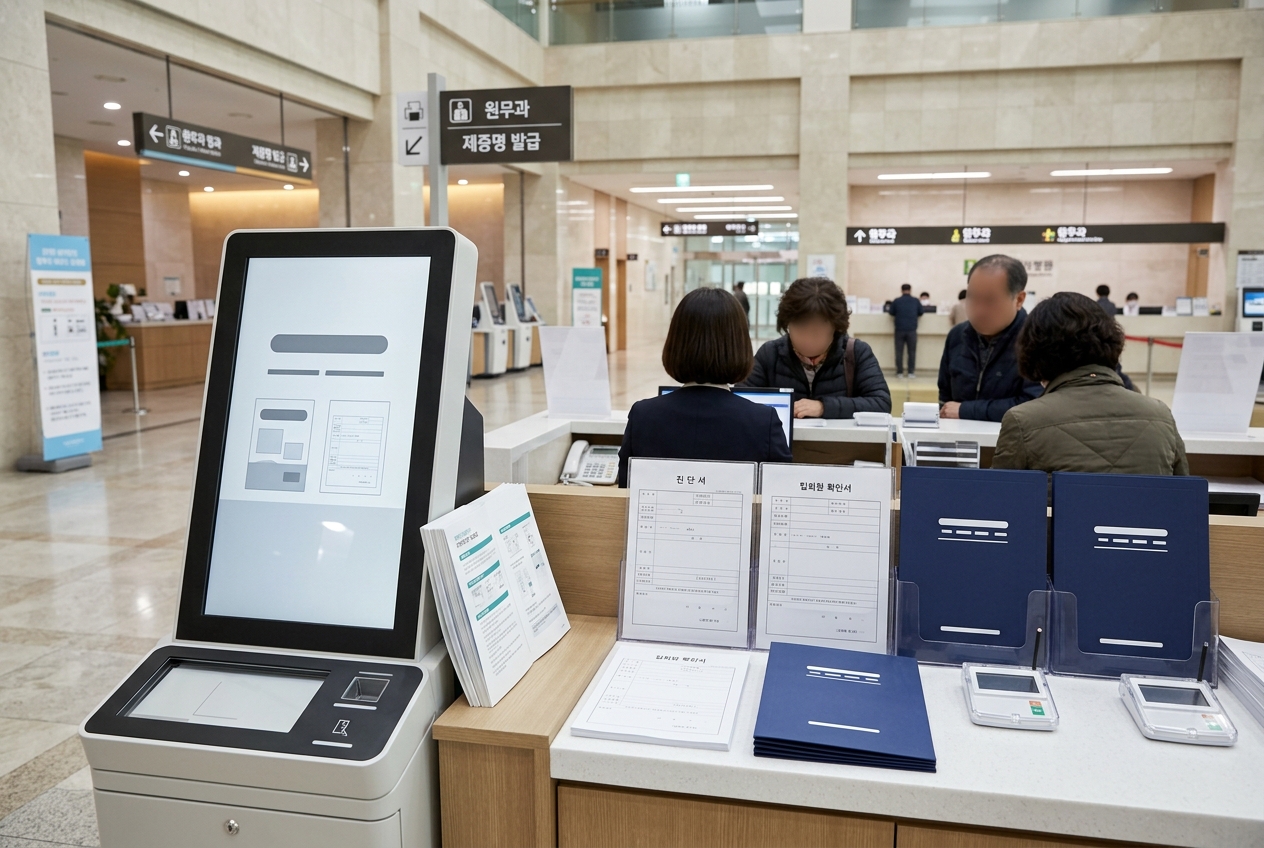
While having all documents is the most certain approach, it can cost more time and money for small claims. Most insurance companies may process claims with just the medical bill receipt for amounts under 100,000 KRW. However, since terms vary by insurance company and enrollment period, you must check the 'possibility of simple claims' through the insurance company's customer center or app. For large claims, document review is very thorough. In these cases, you may be asked for not only a medical certificate but also test results or imaging data (CDs, etc.). Especially for long-term treatment or repetitive manual therapy or physical therapy, documents containing the attending physician's opinion have a significant impact on the review result. If you are a patient receiving periodic treatment, it is advantageous in the long run to get a treatment plan or opinion letter once rather than getting documents every time. Also, even for small claims, if non-covered items are included, it is a good habit to keep the detailed statement for future investigations.
Step 4: Precautions Often Overlooked When Preparing Documents
The most frustrating moment when preparing documents is when the issued documents do not meet the insurance company's standards. To prevent this, be sure to check the following:
Importance of Disease Classification Code
The core of insurance payment is confirming 'is this a covered disease?' The disease classification code on a medical certificate or confirmation is the most important data for the insurance company to decide on coverage. Since receipts often lack this code, be sure to get separate confirmation documents. If the disease code is missing, a request for supplementary documents will be made during the review process, which can delay payment by several days to over a week. Since medical expense insurance has diseases it does not cover (e.g., obesity-related diseases, etc.), checking the code is essential.
How to Use Prescriptions
If you have received a prescription for medication, it is better to submit the prescription with the disease code rather than just the pharmacy receipt. Recently, prescriptions often come with the disease code printed on them, so using this can save the cost of issuing a separate medical certificate. You can get the prescription back from the pharmacy after picking up your medicine, so tell the pharmacist in advance that you 'need a copy for insurance claims.' Prescriptions are very useful not only for claiming drug costs but also as auxiliary data to prove outpatient visits.
Issuance Costs and Cost-Effectiveness
Issuing a medical certificate or opinion letter costs anywhere from a few thousand to tens of thousands of KRW. If the insurance money you are claiming is less than the issuance cost, you might end up losing money. It is wise to ask the hospital administration office about the document issuance fee in advance and selectively request only the necessary documents. Especially when issuing multiple documents at once, costs increase, so you must be aware of the minimum documents required by the insurance company before visiting. Also, it is a good idea to manage issued documents in a digital document box or a separate folder so they are not lost.
Step 5: Taking Action Now
The more you put off medical expense insurance claims, the easier they are to forget, and as time passes, the process of finding hospital records becomes more cumbersome. Based on what you learned today, put the following procedures into practice immediately:
- Install the insurance company's app, check your policy terms, and find the 'Required Document Guide' menu.
- Collect recent medical receipts and check if they have disease codes.
- If there is no disease code, request 'documents for insurance claims' from the administration office on your next hospital visit.
- After confirming the claimable amount, take a photo via the app and submit it immediately.
Medical expense insurance is the legitimate right of the policyholder. Preparing documents may seem complex, but once you get used to it after a time or two, anyone can handle it easily. Especially with the recent development of mobile technology, there are many cases where taking a photo of the document and uploading it is sufficient, so don't feel too burdened. However, depending on your health condition or treatment details, it is most accurate to check once more through the insurance company's call center or your dedicated agent. After filing a claim, you can check the review progress in real-time via app notifications, so don't panic if you receive a request for supplementary documents; just follow the instructions and submit the additional documents. If you receive frequent requests for supplementary documents, it is better to ask the administration office of the hospital you mainly use for their standard document forms in advance.
Insurance claims are half preparation. Keep the list of documents and precautions provided today in your notes and use them effectively on your next hospital visit. To reduce the economic burden while recovering your health, cultivate the habit of carefully checking even the smallest document. Furthermore, if you are aware of your insurance coverage limits and co-payment ratios, it will be a great help in planning your medical expenses. Using insurance for economic stability is the beginning of smart financial management. Now, let go of the fear of preparing documents and start a smart insurance life.
Frequently Asked Questions
Is the receipt enough for a medical expense insurance claim?
In most cases, a 'detailed statement of medical expenses' is required in addition to the medical bill receipt. Also, documents containing the diagnosis name and disease code may be required, so it is recommended to check in advance when visiting the hospital.
The cost of issuing a medical certificate is too expensive; are there alternatives?
Ask the insurance company first if it can be replaced by a prescription or outpatient confirmation that includes the disease code. In many cases, review is possible with documents that cost less to issue than a medical certificate.
Can I submit fewer documents for small claims?
Yes, usually for small claims under 100,000 KRW, claims can often be made with just the medical bill receipt. However, since terms vary by insurance company, it is most accurate to check the claim guide page on the respective insurance company's app.
How do I submit documents when claiming via a mobile app?
You can take a photo of the documents within the app and upload them as image files. At this time, you must take the photo so that the text on the document is clearly visible to avoid delays in the review.
Where can I check the disease code?
You can check it on a medical certificate, outpatient confirmation, or a prescription with the disease code written on it. Please note that it is often not listed on general receipts, so caution is required.